> ## Documentation Index
> Fetch the complete documentation index at: https://programming-for-career.mintlify.site/llms.txt
> Use this file to discover all available pages before exploring further.
# Software Development Life Cycle (SDLC)
> A comprehensive guide to SDLC, covering its phases, various models, and their advantages and disadvantages.
## Introduction
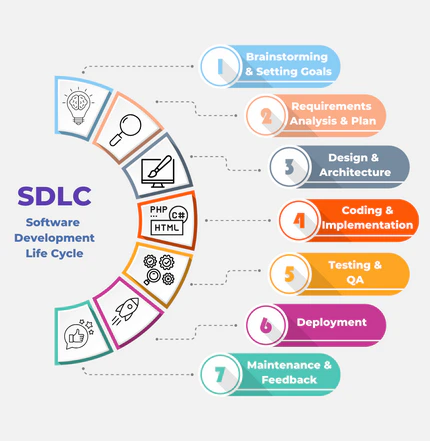
The **Software Development Life Cycle (SDLC)** is a structured process used in software development to ensure high-quality software is developed in a cost-effective and timely manner. It consists of multiple phases that guide the development process from planning to deployment and maintenance.
## Phases of SDLC
1. **Requirement Analysis** – Understanding project needs and gathering user requirements.
2. **Planning** – Defining scope, resources, costs, and timelines.
3. **Design** – Creating architecture and system design.
4. **Implementation (Coding)** – Writing and compiling code based on design specifications.
5. **Testing** – Verifying functionality, security, and performance.
6. **Deployment** – Releasing the software for user access.
7. **Maintenance** – Providing updates, fixing bugs, and improving performance.
 ## SDLC Models
Different SDLC models define how these phases are carried out. Let's explore them in detail.
### 1. Waterfall Model
#### About:
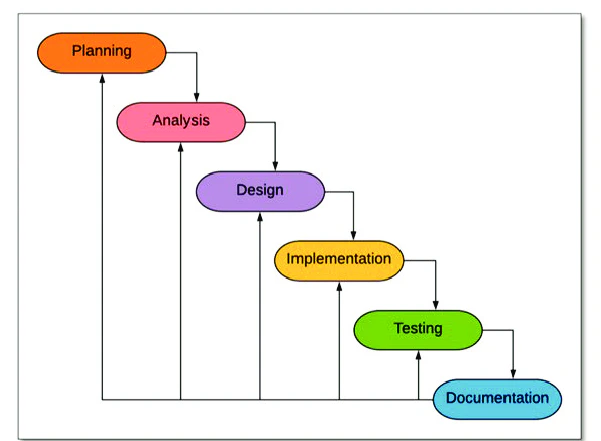
The **Waterfall Model** is a linear and sequential approach where each phase is completed before moving to the next.
#### How It Works:
* Requirements are gathered at the beginning.
* Phases progress in a step-by-step manner.
* Changes are difficult to accommodate once the process has started.
## SDLC Models
Different SDLC models define how these phases are carried out. Let's explore them in detail.
### 1. Waterfall Model
#### About:
The **Waterfall Model** is a linear and sequential approach where each phase is completed before moving to the next.
#### How It Works:
* Requirements are gathered at the beginning.
* Phases progress in a step-by-step manner.
* Changes are difficult to accommodate once the process has started.
 #### Pros:
✅ Simple and easy to understand.
✅ Works well for projects with clear requirements.
✅ Each phase has specific deliverables.
#### Cons:
❌ Not flexible for changes.
❌ High risk of failure if requirements are incorrect.
❌ Testing happens late, which can be costly.
### 2. Agile Model
#### About:
**Agile** is an iterative and flexible approach that delivers software in small, incremental cycles.
#### How It Works:
* Development is divided into short sprints (typically 2-4 weeks).
* Regular feedback is taken from customers.
* Continuous testing and improvement occur throughout development.
#### Pros:
✅ Simple and easy to understand.
✅ Works well for projects with clear requirements.
✅ Each phase has specific deliverables.
#### Cons:
❌ Not flexible for changes.
❌ High risk of failure if requirements are incorrect.
❌ Testing happens late, which can be costly.
### 2. Agile Model
#### About:
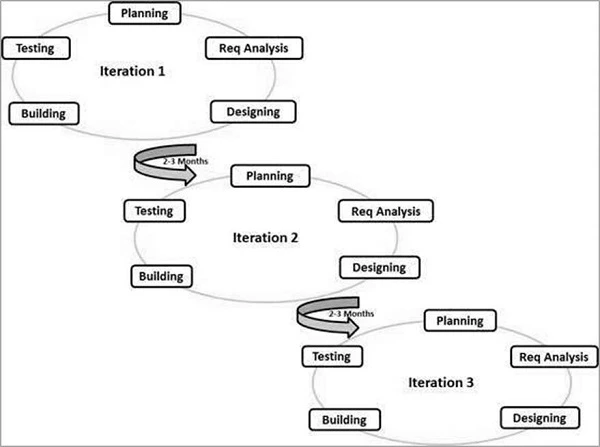
**Agile** is an iterative and flexible approach that delivers software in small, incremental cycles.
#### How It Works:
* Development is divided into short sprints (typically 2-4 weeks).
* Regular feedback is taken from customers.
* Continuous testing and improvement occur throughout development.
 #### Pros:
✅ Highly flexible and adaptable.
✅ Frequent deliveries improve customer satisfaction.
✅ Continuous testing ensures quality.
#### Cons:
❌ Requires constant communication.
❌ Not suitable for small teams or projects with fixed budgets.
❌ Frequent changes can lead to scope creep.
### 3. Spiral Model
#### About:
The **Spiral Model** combines iterative development with risk assessment.
#### How It Works:
* Each iteration follows four phases: planning, risk analysis, development, and evaluation.
* Risks are identified and mitigated early.
* Used for large, complex projects with evolving requirements.
#### Pros:
✅ Highly flexible and adaptable.
✅ Frequent deliveries improve customer satisfaction.
✅ Continuous testing ensures quality.
#### Cons:
❌ Requires constant communication.
❌ Not suitable for small teams or projects with fixed budgets.
❌ Frequent changes can lead to scope creep.
### 3. Spiral Model
#### About:
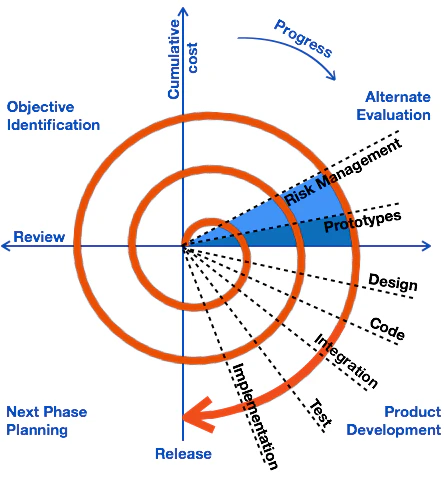
The **Spiral Model** combines iterative development with risk assessment.
#### How It Works:
* Each iteration follows four phases: planning, risk analysis, development, and evaluation.
* Risks are identified and mitigated early.
* Used for large, complex projects with evolving requirements.
 #### Pros:
✅ Risk management is a priority.
✅ Suitable for large-scale projects.
✅ Flexible and iterative.
#### Cons:
❌ Expensive due to risk management efforts.
❌ Complex and time-consuming.
❌ Requires experienced developers.
### 4. Iterative Model
#### About:
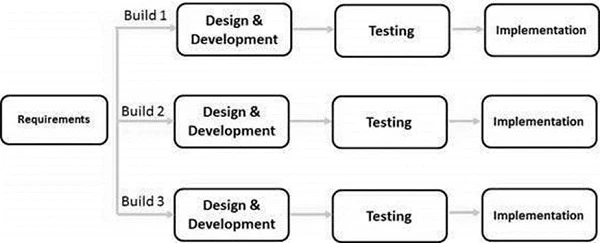
The **Iterative Model** develops software in repeated cycles, refining it over time.
#### How It Works:
* A basic version is built quickly and improved iteratively.
* Each cycle adds new features and fixes problems.
* Used when requirements are unclear at the start.
#### Pros:
✅ Risk management is a priority.
✅ Suitable for large-scale projects.
✅ Flexible and iterative.
#### Cons:
❌ Expensive due to risk management efforts.
❌ Complex and time-consuming.
❌ Requires experienced developers.
### 4. Iterative Model
#### About:
The **Iterative Model** develops software in repeated cycles, refining it over time.
#### How It Works:
* A basic version is built quickly and improved iteratively.
* Each cycle adds new features and fixes problems.
* Used when requirements are unclear at the start.
 #### Pros:
✅ Allows feedback-driven improvements.
✅ Early software versions available.
✅ Suitable for changing requirements.
#### Cons:
❌ More resource-intensive than linear models.
❌ Requires strong planning.
❌ Design flaws may persist if not corrected early.
### 5. V-Model (Validation and Verification)
#### About:
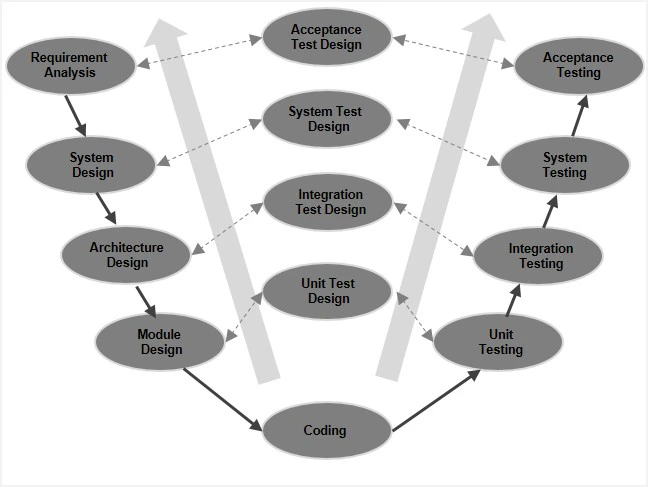
The **V-Model** is an extension of the Waterfall Model where each development phase has a corresponding testing phase.
#### How It Works:
* Each phase has a corresponding validation stage.
* Testing is emphasized early in the process.
* Useful for safety-critical systems like medical and aviation software.
#### Pros:
✅ Allows feedback-driven improvements.
✅ Early software versions available.
✅ Suitable for changing requirements.
#### Cons:
❌ More resource-intensive than linear models.
❌ Requires strong planning.
❌ Design flaws may persist if not corrected early.
### 5. V-Model (Validation and Verification)
#### About:
The **V-Model** is an extension of the Waterfall Model where each development phase has a corresponding testing phase.
#### How It Works:
* Each phase has a corresponding validation stage.
* Testing is emphasized early in the process.
* Useful for safety-critical systems like medical and aviation software.
 #### Pros:
✅ Testing is integrated early, reducing defects.
✅ Well-structured and easy to manage.
✅ Suitable for projects with strict validation requirements.
#### Cons:
❌ Rigid structure, not suitable for dynamic changes.
❌ High documentation overhead.
❌ Can be time-consuming.
## Conclusion
Each **SDLC model** has its strengths and weaknesses. The choice of model depends on project requirements, flexibility, risk, and team structure. Understanding these models helps in selecting the best approach for software development.
#### Pros:
✅ Testing is integrated early, reducing defects.
✅ Well-structured and easy to manage.
✅ Suitable for projects with strict validation requirements.
#### Cons:
❌ Rigid structure, not suitable for dynamic changes.
❌ High documentation overhead.
❌ Can be time-consuming.
## Conclusion
Each **SDLC model** has its strengths and weaknesses. The choice of model depends on project requirements, flexibility, risk, and team structure. Understanding these models helps in selecting the best approach for software development.